Edmonton’s North Saskatchewan River Valley, long a protected haven for wildlife and a green refuge for residents, is under threat. Green spaces and natural protected areas are key to making cities safer places to live as the climate crisis worsens. Members of the Edmonton Climate Hub have been working tirelessly to raise awareness, build dialogue with city officials and bring about lasting policy change to protect this precious landscape that is deeply embedded in all aspects of life in Alberta's capital city. Their story is one that can inspire cities and communities everywhere to act for climate resilience through civic engagement..
This August, Edmonton city council voted to move forward with an overhaul of the North Saskatchewan River Valley Area Redevelopment Plan, a bylaw that for decades has safeguarded the valley’s ecological and cultural integrity. Under the new rules, projects smaller than 10,000 square metres (an area roughly the size of two football fields) can now bypass council oversight, leaving key development decisions in the hands of city administration.
In the eyes of advocates, this threshold is alarmingly high. It means major developments can move forward without public hearings or elected representatives weighing in. And according to Raquel Feroe, a retired physician and member the Edmonton Climate Hub and the Edmonton River Valley Conservation Coalition (ERVCC), this shift puts the valley’s future at risk. She notes the work of the Hub and ERVCC are fully aligned in recognizing the need to protect the river valley.
“The North Saskatchewan River Valley is basically the backbone of our ecologic connectivity here in Edmonton,” Raquel says. “It’s our water source, so it’s literally our life — [as well as] our lifeline in times of climate change and biodiversity loss.”
A corridor of life and connection
The North Saskatchewan River Valley is more than local parkland. It’s a regionally significant wildlife corridor, linking the Rocky Mountains to the Beaver Hills Biosphere east of Edmonton. Part of the endangered Aspen Parkland ecozone, it’s one of the last green threads tying together boreal forest and prairie. It’s also one of Canada’s most threatened ecoregions, impacting many species; yet in Edmonton, it still has wolves, deer and countless other species moving through the valley, relying on its continuity to survive.

Edmonton’s North Saskatchewan River Valley is home to diverse creatures and wildlife, including their beloved birds and butterflies.
But that continuity is fragile. According to Kecia Kerr, executive director of the northern chapter of the Canadian Parks and Wilderness Society, the valley has since 2005 lost more than four per cent of its natural areas. Across Edmonton as a whole, the loss is closer to 11 per cent.
Conservationists warn that without stronger protection, natural spaces within city limits will become exceedingly rare. Developments and new trails risk compounding the pressure on already narrow wildlife ‘choke points.’
The newly passed bylaw, rather than addressing these risks, weakens the safeguards that once preserved the valley. “Now, a whole lot more that could not have happened historically will be able to happen,” Raquel clarifies. “Projects just won’t have to go back to the city council for second sober thought.”
Most important is understanding how the valley acts as a social equalizer by being a place everyone in the city can feel welcome, included and connected. Its role in supporting mental health and community well-being is just as significant as its ecological function..
This universal accessibility is no accident. Edmonton’s early planners recognized the unique value of the valley, as well as the risks of building on steep banks and floodplains. With advice from landscape architects, they chose instead to preserve the valley as a continuous park system. Their foresight meant Edmonton, unlike many other large northern cities, retained a functioning urban ecosystem at its core.
“That vision has been alive for 100 years because settlers had been welcomed to a rich gathering place that First Nations have stewarded for millennia,” Raquel explains, “and it’s slowly been embodied into a bylaw called the North Saskatchewan River Valley Bylaw, or the River Valley Area Redevelopment Plan.”
But today, she warns, that vision threatens to fall apart entirely.
Public pushback, political pressures
At the August 18 council meeting, Edmontonians from across the city spoke out. Groups like the Canadian Parks and Wilderness Society Northern Alberta, the Environmental Law Centre, the Edmonton River Valley Conservation Coalition and individual residents urged councillors to strengthen, not weaken, the bylaw.
Some called for ‘ecological integrity’ to be embedded directly into urban planning frameworks — as has been done in other Canadian cities like London — such that natural areas can still be enjoyed for recreational purposes while prioritizing ecological health and protection. Others stressed that that development initiatives should be focused elsewhere, keeping pressure and exploitation completely off the valley.
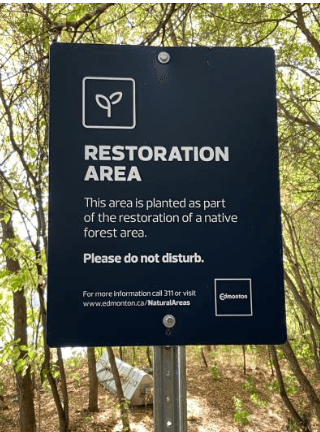
A sign in the North Saskatchewan River Valley where ERVCC, Hub members and the City of Edmonton are restoring land that has not been treated with proper respect and reciprocity. The sign reads: “Restoration Area: This area is planted as part of the restoration of a native forest area. Please do not disturb.”
A motion from Councillor Jo-Anne Wright to send the plan back for revisions that would reinforce protections was narrowly defeated. The final vote to proceed was unanimous, with several councillors citing a desire to balance environmental protection with access. For many residents, however, the outcome was deeply disappointing.
Raquel attributes the situation to troubling dynamics at play. In her view, upper management at city hall has grown too close to the priorities of developers and international consulting firms eager to see more cement get poured. This creates pressure to prioritize infrastructure spending and short-term economic gains over long-term sustainability.
Rather than embedding ecology at the foundation of decision-making, she observes a tendency to ‘trade off’ environmental, economic and social considerations as though they were equal parts of a ledger. But, as she emphasizes, “you need to always consider the ecology first... or you can lose the ecology.”
Honouring Indigenous rights and knowledge
Beyond ecological concerns, the redevelopment plan raises questions about Indigenous rights. Edmonton currently has in place an Indigenous framework that references the United Nations Declaration on the Rights of Indigenous Peoples (UNDRIP), including the principle of free, prior and informed consent.
But speakers at City Hall like Thunderchild First Nation members Miranda Jimmy and many settler speakers like Raquel pointed out that the framework is not being fully honoured. In practice, engagement with First Nations has often meant being informed of development plans that are already drafted, rather than being invited to consider and co-create them from the very beginning. This is a missed opportunity and particularly problematic given that Indigenous leadership in conservation is growing, with the vast majority of protected areas in Canada established since the late 1990s being Indigenous-led or co-led.
“You don’t just invite people for input on something you’re already planning,” Racquel stresses. “You engage rights holders, to consider and plan with you. You benefit from their planning knowledge, from their perspectives.” Learning from leaders like Miranda Jimmy, she advises everyone to read Edmonton’s Indigenous Framework.
Without true nation-to-nation consultation, the ‘modernized’ bylaw threatens to sideline Indigenous sovereignty over their land and perpetuate old patterns of exclusion. By limiting the participation of First Nations communities to feedback on pre-drafted plans, the city diminishes the role of traditional knowledge and misses a vital opportunity to embed Indigenous stewardship practices into the protection and management of the river valley.
Protecting the valley, protecting the future
Racquel first joined the Edmonton Climate Hub when its co-chairs began convening the community. Eager to learn from people deeply involved in ecology and net-zero planning, what she found was a collective of residents all eager to work toward planetary health.
Since then, she has deepened her advocacy by connecting local climate action to city policy, lending her voice to campaigns, public consultations and education efforts around the North Saskatchewan River Valley.
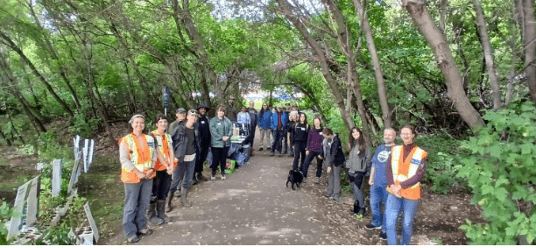
Members of the Edmonton River Valley Conservation Coalition pose for a photo in the North Saskatchewan River Valley.
Her appreciation for the valley is in large part shaped by her own experience of Edmonton. Having moved to the city in 1988 from a much larger urban centre, and with the perspective of a historian husband who underscored the role of long-term vision in protecting the valley, Racquel has come to see just how rare and valuable this green corridor is compared to most big cities. That perspective, she notes, makes her all the more convinced that Edmontonians need to ‘wake up’ and reaffirm their commitment to protecting what earlier generations worked so hard to preserve.
For her, protecting the valley is inseparable from Alberta’s larger climate justice movement. The valley cools Edmonton during the summer, mitigates flooding, sequesters carbon and provides habitat for pollinators and wildlife. It’s a natural ally in the fight against climate change.
It’s also, just as importantly, a teacher. “As we learn to have a better relationship with the land here, we learn to have better relationships with each other,” Racquel reflects. “It's where we learn the culture of living together, of sharing, of long-term thinking. By reconnecting to the river valley land, we can develop a culture of caring and working together to find the true abundance we need to mitigate and to adapt to climate change.”
The fight to protect the valley, in other words, goes beyond preserving green space. It offers a living model of reciprocity, where human well-being and ecological health are fundamentally interlinked. Defending it is about reshaping how Edmontonians understand their relationship to land, water and each other. It’s about shifting the values that communities in Alberta will need in order to face a rapidly warming world.
The road (or corridor) ahead
The updated bylaw did not take effect until just this November. During this time, advocates have been continuing to raise awareness about the harmful ecological implications of the plan, pushing for meaningful Indigenous consent and making clear to the city council that the North Saskatchewan River Valley’s long-term health must take precedence over short-term development interests.
Through public outreach, policy advocacy, community education and alliances with traditional Elders (and increasingly, youth), Racquel and others in the Edmonton Climate Hub are working to ensure that every future decision affecting the river valley considers cumulative impacts on wildlife, water quality, flood mitigation and climate resilience. Their goal is to make ecological integrity non-negotiable, so that the valley remains a thriving habitat for wildlife and a green refuge for all, now and for generations to come.
Naturally, this work goes beyond any single bylaw or development project. It’s about cultivating a long-term ethic of stewardship, where the voices of local residents, Indigenous communities and ecological experts are all part of the decision-making process.
And ultimately, by embedding respect for nature and thoughtful planning into the city’s governance, the Hub — alongside everyday Edmontonians — is helping to build a model for how cities can grow responsibly and sustainably, demonstrating that urban development does not and should never have to come at the expense of the ecosystems that sustain them.
Learn more about the North Saskatchewan River Valley conservation efforts.